Downtown learns to run on current
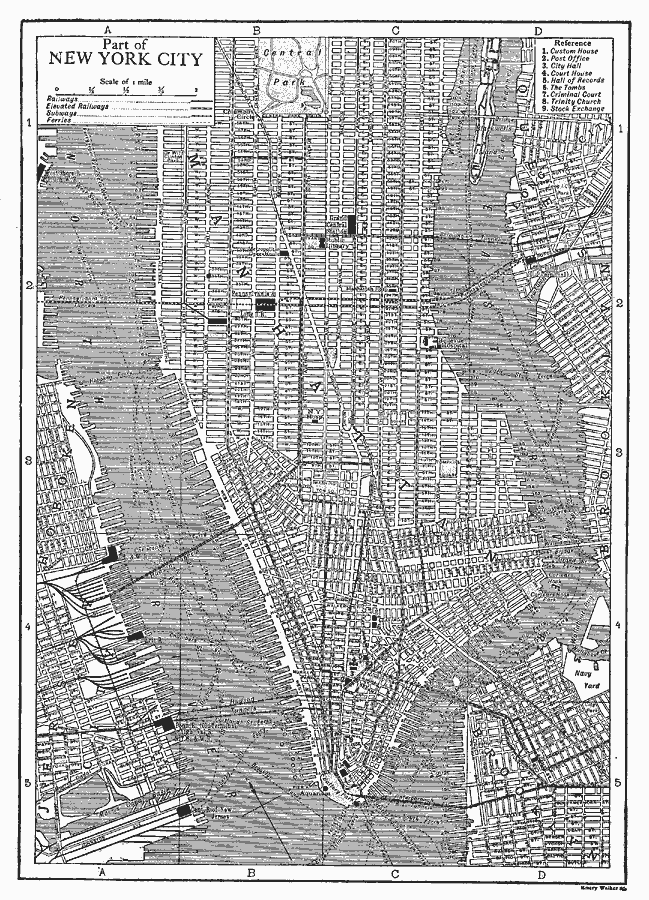
The early named work gathers around Lower Manhattan and Union Square, where private plants, telephones, church work, and skyscraper systems made electricity part of a building's anatomy.
Business in the city
The city path keeps Pattison Brothers concrete. Churches, skyscrapers, libraries, theatres, hospitals, campuses, and civic rooms become places where family work met public need.
The early named work gathers around Lower Manhattan and Union Square, where private plants, telephones, church work, and skyscraper systems made electricity part of a building's anatomy.
Hospitals, universities, theatres, and the new library needed power, motors, lifts, lights, and safety systems to co-operate as one disciplined organism.
By the nineteen-twenties and nineteen-thirties the firm name appears in financial, religious, hospital, and courthouse work as New York's civic geography stretches uptown and into the Bronx.
1895 / Faith and social service
Grace Chapel is the young firm learning that electricity was not only for offices and factories. It was also for worship, care, parish rooms, and a little institutional city on one block.
Enter this place
1897 / Tall-building plant
The St. Paul Building is the office stepping into height. It is not merely a commission; it is a test of whether a skyscraper can be made orderly inside.
Enter this place1906-1908 / Commerce and exchange
The Methodist Book Concern is a quieter character: a publisher's building whose machinery had to serve offices, presses, lifts, heat, and institutional continuity.
Enter this place
1897-1911 / Public house and landmark
The Library is Frank in public. He is no longer only a consulting name in a trade column; the newspaper lets the family watch him guide hundreds of engineers through a civic machine.
Enter this place
1909 / Theatre and spectacle
The New Theatre is beloved family memory meeting the discipline of the record. It keeps the drama, but moves the credit to the right machinery.
Enter this place1904-1914 / Hospital care and power
Harlem Hospital is the public-health character: a building where electricity is not glamour but reliability, ventilation, heat, lifts, and the daily discipline of care.
Enter this placeReported 1913 / Campus heat, light, power
The NYU plant is a campus heart. Its work was not to be admired from the street but to let a hilltop university live as one connected body.
Enter this place1921-1923 / Commerce and exchange
The Cotton Exchange is commerce turned into a building. By the nineteen-twenties, the firm is still present when finance needs elevators, electric work, and mechanical confidence.
Enter this place
1926 / Church in the vertical city
Broadway Temple is a church trying to live in the vertical city. Its engineering story is elevators and current serving a congregation that built upward.
Enter this place1931-1934 / Public house and landmark
The Bronx courthouse is the late witness. It appears after Charles's death and near the end of Frank's working life, showing that the firm name still had professional force.
Enter this place